A long and bitter funding winter in the start-up world is beginning to take its toll on start-up advertising across properties. Earlier this week, Mastercard replaced Paytm as the title sponsor for all international and domestic cricket matches organised by the Board of Control for Cricket in India (BCCI). But this is just one part of the story. The other side is that organisers of high-impact shows and events on Hindi general entertainment channels, too, are feeling the winter chill.
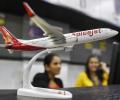
In an unprecedented action, Indian aviation regulator DGCA has directed low-cost airline Spicejet to operate only 50 per cent of its flights for eight weeks. This follows an unusually high number of incidents involving the airline, raising safety concerns. The curtailment of capacity is unlikely to have any commercial impact on the airline owned by entrepreneur Ajay Singh. SpiceJet already operates less than 50 per cent of the flights it had filed for the summer schedule.

Tata group-owned AirAsia India's inability to get approval for international flights is hurting UDAN, the Indian government's regional air connectivity project that also aims to link cities in Northeast India and Odisha to places abroad. Sources said the civil aviation ministry is waiting for the low-cost airline to come under the full ownership of Tata Sons and become part of Air India, the former state-owned carrier now owned by the private conglomerate, before allowing it to operate international flights. Tata owns 84 per cent stake in AirAsia India and it is understood that the group will complete the process of buying rest of the stake by July's end.

Hindustan Zinc (HZL), a subsidiary of Vedanta, announced an interim dividend of Rs 21 per share last week, resulting in an outflow of Rs 8,863 crore. The announcement has turned the spotlight on India Inc's dividend-paying policy - more so for reasons driving the generosity of firms. An analysis of BSE 500 companies by Business Standard Research Bureau shows that some of the top 20 dividend-paying companies in 2021-22 (FY22) include Vedanta, Tata Consultancy Services, HZL, Oil and Natural Gas Corporation (ONGC), Indian Oil Corporation (IndianOil), Hindustan Unilever (HUL), Reliance Industries (RIL), and Bajaj Auto, among others.

Failure to reinstate salary even two years after the drastic cuts has landed the airline industry in a massive industrial relation crisis. While employees of Air India had organised a strike back in 2011, it is for the first time that private airlines are facing serious stress related to workers. IndiGo witnessed two of them, back to back. In the first instance, around 50 per cent of the IndiGo flights were delayed as a large number of crew members went on mass sick leave, apparently to participate in a rival airline's walk-in job interview.

As the Indian currency hovers around its lowest versus the US greenback, several smaller and mid-sized companies are expected to face rough weather as almost 44 per cent of the foreign loans taken by Indian companies remained unhedged. According to the data sourced from the Reserve Bank of India, Indian companies raised around $38.2 billion in the financial year ended in March. Of this, only 56 per cent of the loans are hedged while the rest of the foreign loans remain unhedged, thus risking the companies to forex volatility.
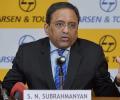
Engineering giant Larsen & Toubro (L&T) handed out a pay cheque of Rs 61.27 crore to its chief executive officer (CEO) and managing director (MD) SN Subrahmanyan in the last financial year (FY22), which is a near 115 per cent hike over FY21, as executive compensation at India Inc comes under sharp focus after two years of Covid-19. In fact, the total compensation of L&T's executive directors (including Subrahmanyan) in FY22 was 120 to 670 times the median remuneration of the company's employees, data from its FY22 annual report shows. This points to sharp hikes that the top management saw in their remuneration during the period, experts in human resources said. In FY21, L&T's executive compensation was 56 to 337 times the median remuneration of company employees.

Jet Airways is looking to lease around 20 Airbus A320 aircraft from lessors by 2024 as it aims to restart operations and fly international routes in the next one-and-a-half years. Jet's A320 aircraft fleet, according to sources, will be a mix of the Ceo and the more fuel-efficient Neo variants. These planes were originally intended for Russian airlines but could not be delivered following western sanctions on Russia over its Ukraine invasion.

'The second half of 2022 definitely looks stronger for Bollywood.'

More than 1,600 employees of Air India, the former state-run carrier now owned by the Tata group, have opted for voluntary retirement under a scheme announced on June 1. These employees comprise 22 per cent of permanent staff (around 7,000). The airline has a total employee strength of around 10,800, including those on contract.

Even as Union ministers allay misgivings over Agnipath, figures show a meagre 2.4 per cent of the ex-servicemen who applied for a government job could get one as the Centre and the states have been unable to recruit against the reserved quotas. Public sector undertakings (PSUs), ministries, and officials of Sainik Boards have blamed it on the lack of skill among ex-servicemen. They say veterans' inability to qualify in selection exams is one of reasons for this. Also, non-recognition of qualifications obtained from the military are reasons why their recruitment has remained significantly low, pushing them towards low-skill jobs.
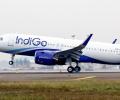
'We should have calmed down the child. We will do an internal analysis on that.'

An opportunity to enter a burgeoning sector at a low valuation and favourable policies are propelling some of India's largest corporate groups to scoop up drone start-ups. "Indian corporations lost the race in aerospace and space tech. "No one wants to miss the bus this time. "These are seasoned businessmen and they realise that the market cap of tech companies with problem-solving capabilities will exponentially rise in future," says Vipul Singh, CEO of Aarav Unmanned Systems (AUS).
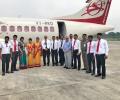
Tata-owned Air India has launched a Voluntary Retirement Scheme (VRS) for its employees- in the airline's first drive to reduce headcount. The salt-to-steel conglomerate acquired the carrier last year. As of November 2019, the airline had 9,426 permanent employees.

Engineering giant Larsen & Toubro (L&T) is looking to divest its exposure to road and power concessions and incubate digital and e-commerce businesses as part of its new five-year plan ending 2025-26 (FY26). The base year for the plan is 2020-21 (FY21). The blueprint, called Lakshya 2026, is intended to help the company exit sub-scale businesses, concentrate on high-technology (tech) manufacturing, construction and green energy projects, and increase its share from information technology (IT) and digital services. The lending operations of the financial services business, meanwhile, will be reorganised, with focus on retail lending.

Hundreds of pilots are staring at a long wait to get the job of their dreams after completing the course, the cost of which runs to Rs 1 crore.

American automaker Ford on Thursday said that it had withdrawn plans to manufacture electric vehicles (EVs) in India and it won't invest in the country under the performance-linked incentive (PLI) scheme. "After careful review, we have decided to no longer pursue EV manufacturing for exports from any of the Indian plants. "We remain grateful to the government for approving our proposal under the PLI and for being supportive while we continued our exploration. "Ford India's previously announced business restructuring continues as planned, including exploring other alternatives for our manufacturing facilities.

Maruti's strategy for the SUV segment is to arrest the decline in customers for entry level hatchbacks.
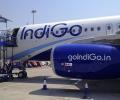
Disability rights came under the spotlight again as the country's largest airline IndiGo refused to let a teenager with special needs board its aircraft. While the twitterati as well as fellow passengers have called for strict action, IndiGo has stood by its action saying the airport manager took the decision to ensure safety of other passengers. "Throughout the check-in and boarding process, our intent of course was to carry the family. "However, at the boarding area, the teenager was visibly in panic.

Power generating companies (gencos) that use imported coal to produce electricity, may find it difficult to switch on their idle units immediately in the wake of high fuel costs, several players have told Business Standard. Recently, the Union power ministry had invoked Section 11 of the Electricity Act mandating all imported coal-based plants to generate power at full capacity. However, some generating companies that use imported coal, argue that it is simply unviable for them to produce power when the price of coal in the international market is high, while the per-unit price of power has been capped at Rs 12 per unit on the domestic power exchange.
 © 2026 Rediff.com - Advertise with us - Disclaimer - Privacy Policy - Sitemap - Feedback - About us - Terms of use - Grievances